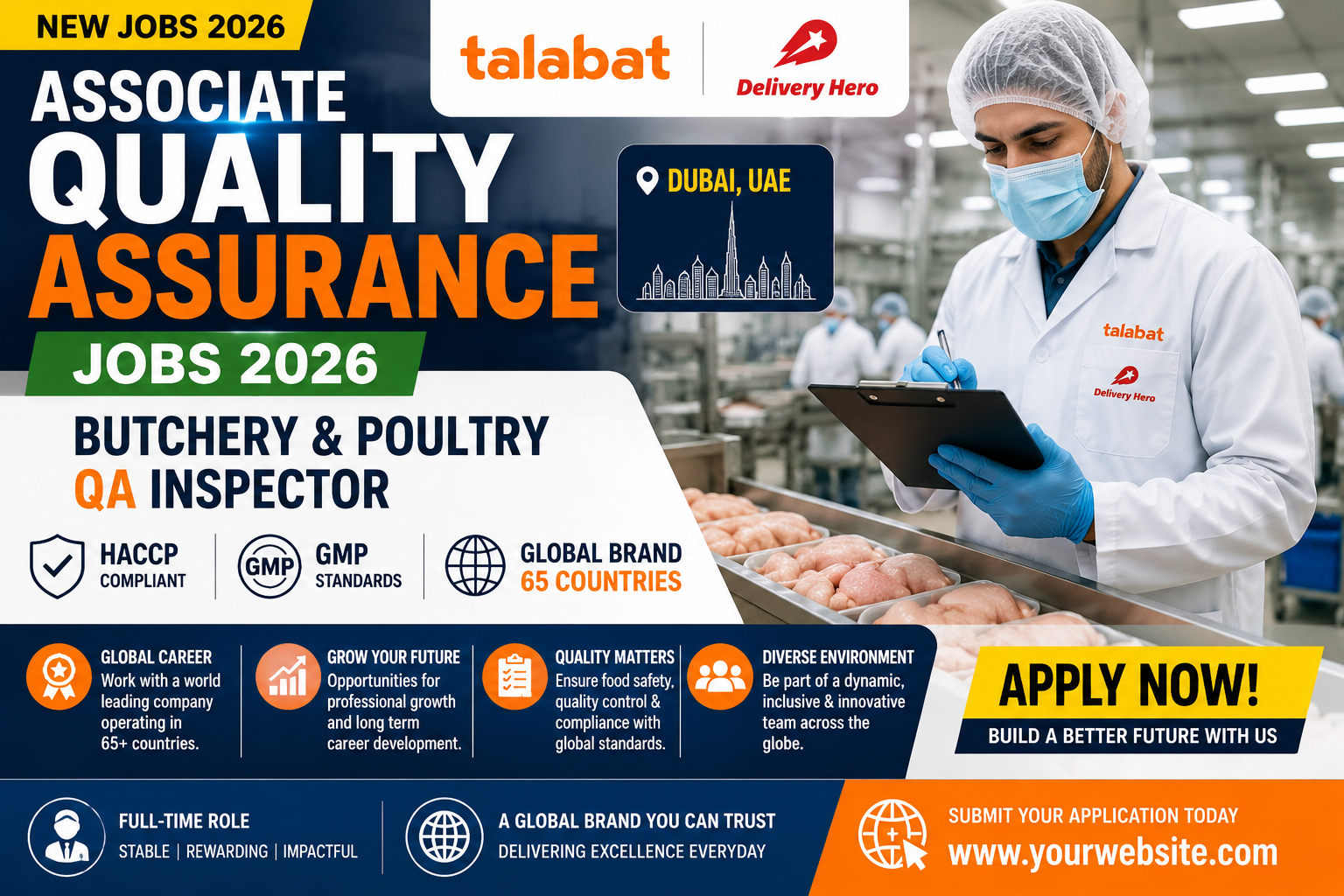
Talabat Delivery Hero Hiring Associate Quality Assurance Inspector | Butchery Poultry Manufacturing | HACCP Certified | Food Safety Career 2026
Are you an experienced Associate Quality Assurance professional with a strong background in butchery, poultry processing, or food manufacturing quality control? Talabat — part of the globally renowned Delivery Hero Group, the world’s pioneering local delivery platform operating across 65 countries worldwide — is actively recruiting a talented Associate Quality Assurance Inspector ready to uphold the highest possible food safety, quality, and regulatory standards within a world-class manufacturing facility.
This is a genuinely exciting opportunity to build your food safety and quality assurance career within one of the most recognised, fastest-growing, and globally impactful food delivery organisations on the planet — combining technical QA expertise with the scale, resources, and professional development opportunities that only a Frankfurt Stock Exchange-listed global company can provide.
About Talabat and Delivery Hero Group
Talabat is one of the most recognised and trusted food delivery platforms across the Middle East and beyond, operating as a core part of the Delivery Hero Group — the world’s pioneering local delivery platform on a mission to deliver amazing experiences fast, easy, and directly to customers’ doors.
Company Highlights:
- Part of Delivery Hero Group — world’s pioneering local delivery platform
- Operations spanning 65+ countries worldwide across multiple continents
- Headquartered in Berlin, Germany with strong regional presence across Middle East
- Listed on the Frankfurt Stock Exchange since 2017 — part of the MDAX stock market index
- Mission: delivering amazing experiences — fast, easy, and to your door
- One of the most recognised food delivery brands across the Middle East region
- Rapidly growing manufacturing and fulfilment operations requiring world-class quality teams
- Culture of innovation, excellence, and customer-first delivery at every level
Position Details: Associate Quality Assurance Inspector
Job Title: Associate Quality Assurance Inspector
Company: Talabat | Delivery Hero Group
Industry: Food Manufacturing | Quality Assurance | Butchery & Poultry Processing | Food Safety
Job Type: Full-Time Permanent
Location: Manufacturing Facility — On-Site
Career Level: Associate Level | Quality Assurance Professional
Certifications Required: Food Safety Certification — HACCP, GMP, or equivalent (essential)
Languages: English (fluent, written and spoken) | Arabic (advantageous)
Reporting Structure: Quality Assurance and Manufacturing Operations Teams
Role Overview: Associate Quality Assurance Inspector
As Associate Quality Assurance Inspector at Talabat, your primary focus centres on the systematic inspection of butchery and poultry products within the manufacturing facility — ensuring every product that passes through the production process adheres completely to established quality standards, food safety regulations, and customer specifications before reaching Talabat’s millions of customers across the region.
Your work sits at the absolute frontline of food safety and quality protection — directly responsible for ensuring that the products Talabat delivers to customers meet the highest possible standards of safety, freshness, cut specification accuracy, and packaging integrity.
Working closely with production employees, manufacturing managers, and the wider Quality Assurance team, you’ll build strong operational relationships, maintain rigorous inspection disciplines, and contribute actively to the continuous improvement culture that defines Talabat’s commitment to delivering genuinely amazing customer experiences.
Key Responsibilities: What’s On Your Plate
Standard Operating Procedure Comprehension and Application
SOP and Specification Mastery:
Read, understand, and apply Standard Operating Procedures (SOPs) and product specifications thoroughly — developing comprehensive knowledge of quality expectations for every butchery and poultry product category within the manufacturing facility’s production portfolio.
Maintain current, accurate understanding of specification updates, regulatory changes, and quality standard revisions — ensuring inspection activities always reflect the most current applicable requirements rather than outdated procedures.
Quality Expectation Alignment:
Translate written SOPs and specifications into consistent, accurate, and repeatable inspection practices — ensuring quality checks deliver reliable, meaningful results that genuinely protect product integrity and consumer safety across every production run.
Sample Selection and Quality Inspection
Raw Material Sampling:
Select representative raw material samples from incoming butchery and poultry ingredients using statistically valid sampling methodologies — ensuring inspection results accurately reflect the quality characteristics of entire incoming batches rather than simply cherry-picked individual items.
Finished Product Inspection:
Conduct thorough finished product quality checks applying appropriate inspection methods tailored to specific product categories — including weight verification, cut specification assessment, temperature measurement and control, packaging integrity evaluation, and visual presentation standards.
Inspection Method Application:
Apply the correct inspection methodology for each specific product type and quality parameter — understanding that different butchery cuts, poultry products, and processing stages require different inspection approaches to identify relevant quality deviations effectively.
Documentation Accuracy:
Record all inspection findings with precision and completeness — maintaining the documentation integrity that enables meaningful trend analysis, regulatory compliance demonstration, and continuous quality improvement initiatives.
Measuring Instrument Use and Calibration
Instrument Proficiency:
Operate and maintain a range of precision measuring instruments including calibrated thermometers for temperature control verification, accurate scales for weight and portion measurement, moisture analyzers for product quality assessment, pH meters for freshness evaluation, and other specialist quality measurement tools.
Calibration Management:
Perform regular instrument calibration according to established schedules and procedures — maintaining the measurement accuracy that underpins every quality and food safety determination made during production inspections.
Measurement Accuracy:
Apply precise measurement techniques that generate reliable, reproducible results — understanding that inaccurate measurements create false quality assurances that ultimately compromise both food safety and customer experience.
Equipment Maintenance:
Maintain all quality measurement equipment in optimal working condition — reporting equipment failures, calibration discrepancies, or maintenance requirements promptly to ensure inspection capability is never compromised by equipment issues.
Test Result Analysis and Non-Conformity Identification
Inspection Data Analysis:
Analyse test results and inspection data systematically to identify deviations, non-conformities, and emerging quality trends related to food safety standards, product specifications, and regulatory requirements — moving beyond simple pass/fail assessments to genuine quality intelligence.
Non-Conformity Detection:
Apply strong analytical attention to detect non-conformities across all quality parameters — including microbiological risks, physical contamination, temperature abuse, specification deviations, packaging failures, and labelling inaccuracies that could compromise product safety or customer satisfaction.
Trend Identification:
Recognise recurring patterns in quality data that indicate systematic process issues requiring investigation and correction — contributing proactively to root cause analysis rather than simply documenting individual non-conformities in isolation.
Risk Assessment:
Apply food safety risk assessment principles to inspection findings — prioritising corrective actions appropriately based on the severity of identified non-conformities and their potential impact on consumer safety and product quality.
Reporting, Documentation, and Corrective Action
Inspection Report Preparation:
Prepare clear, accurate, and comprehensive inspection reports documenting all quality findings, non-conformities identified, measurement data recorded, and corrective actions recommended — creating the audit trail that demonstrates quality system effectiveness.
Non-Conformity Documentation:
Document all identified non-conformities with sufficient detail to enable effective root cause investigation — recording product identification, inspection parameters, measurement results, observed deviations, and immediate actions taken at point of detection.
Corrective Action Recommendations:
Develop and communicate practical, evidence-based corrective action recommendations for identified quality issues — working collaboratively with production teams to implement solutions that address root causes rather than simply treating visible symptoms.
HACCP Protocol Adherence:
Follow established HACCP (Hazard Analysis and Critical Control Points) protocols rigorously — monitoring Critical Control Points, verifying CCP records, and ensuring all documentation meets regulatory and certification requirements at all times.
GMP Compliance:
Maintain strict adherence to GMP (Good Manufacturing Practice) standards across all quality inspection activities — modelling the professional hygiene, documentation, and operational discipline standards expected throughout the manufacturing environment.
Production Team Relationship Building
Cross-Functional Collaboration:
Build and maintain strong professional relationships with production employees, line supervisors, and manufacturing managers — creating the collaborative working environment where quality compliance is genuinely shared responsibility rather than externally imposed obligation.
Quality Culture Development:
Contribute actively to building a positive quality culture throughout the manufacturing facility — communicating quality standards clearly, recognising good compliance practices, and addressing non-compliance constructively rather than punitively.
Communication Excellence:
Communicate inspection findings, quality requirements, and corrective actions clearly, professionally, and constructively to production colleagues at all levels — from frontline butchery operatives through to senior manufacturing management.
Training Support:
Support production team members in understanding quality requirements, inspection standards, and food safety protocols — contributing to the knowledge base that enables teams to self-monitor quality standards proactively throughout the production process.
Essential Qualifications and Technical Requirements
Experience Requirements
Quality Inspection Background:
Proven experience as a Quality Inspector, QA Technician, or equivalent role within a butchery, poultry manufacturing, or food processing facility — bringing practical understanding of food manufacturing quality challenges to every inspection activity.
Butchery and Poultry Specialisation:
Butchery experience or strong working knowledge of meat cutting specifications and poultry processing is highly preferred — understanding how specific production processes impact product quality and what inspection parameters matter most for different product categories.
Manufacturing Quality Control:
Strong working knowledge of manufacturing quality control processes applicable to food production environments — including incoming material inspection, in-process quality checks, finished product release, and non-conformance management.
Certification Requirements
Food Safety Certification — Essential:
A current, recognised Food Safety Certification is absolutely essential for this role. Acceptable certifications include:
- HACCP Certification — Hazard Analysis and Critical Control Points
- GMP Certification — Good Manufacturing Practice
- Food Safety Level 3 or equivalent national or international qualification
- Other recognised food safety management system certifications
These certifications demonstrate the foundational food safety knowledge required to perform inspection activities that genuinely protect consumer safety within a regulated manufacturing environment.
Technical Knowledge Areas
Meat and Poultry Quality Inspection:
Comprehensive knowledge of meat and poultry quality inspection techniques — including visual assessment, temperature monitoring, cut specification verification, freshness evaluation, and packaging integrity assessment specific to butchery and poultry product categories.
Food Safety Procedures:
Strong understanding of food safety procedures applicable to meat and poultry processing — including temperature control requirements, cross-contamination prevention, allergen management, and microbiological risk control.
Measuring Instrument Familiarity:
Practical experience with thermometers, pH meters, calibrated scales, moisture analyzers, and other precision measurement instruments used in food manufacturing quality control environments.
QA/QC Principles:
Solid understanding of Quality Assurance and Quality Control principles — understanding the distinction between proactive quality assurance system management and reactive quality control inspection activities.
Personal Competencies
Exceptional Attention to Detail:
The meticulous attention to detail required to detect subtle quality deviations, measurement discrepancies, and specification non-conformities that less observant inspectors might miss — understanding that overlooked quality issues ultimately reach consumers.
Strong Problem-Solving:
Demonstrated problem-solving capability enabling rapid, accurate identification of quality issue root causes and development of practical corrective actions that prevent recurrence rather than simply addressing immediate symptoms.
Independent Working Capability:
Ability to work independently and make appropriate quality decisions without constant supervision — taking personal ownership of inspection quality and demonstrating the professional judgment that food safety responsibilities demand.
Effective Communication:
Clear, professional communication skills enabling effective collaboration with production teams, quality colleagues, and management — adapting communication style appropriately for different audiences and circumstances.
Language Requirements
English — Essential:
Fluent English proficiency in both written and spoken forms is mandatory — required for reading SOPs, completing inspection documentation, communicating with management, and maintaining quality records.
Arabic — Advantageous:
Arabic language knowledge is a valuable additional asset — enabling more effective communication with production team members in Arabic-speaking manufacturing environments and enhancing cross-functional collaboration quality.
Why Build Your QA Career with Talabat and Delivery Hero
Global Brand Scale and Stability
Joining Talabat and the Delivery Hero Group means becoming part of one of the most financially robust, globally recognised, and rapidly expanding food technology companies in the world. With Frankfurt Stock Exchange listing and MDAX index inclusion, Delivery Hero’s financial stability provides exceptional employment security alongside exciting growth opportunities.
Unique Industry Position
Talabat’s manufacturing and quality operations sit at the intersection of food technology innovation and traditional food safety expertise — creating a uniquely stimulating environment where modern quality management approaches are applied to traditional butchery and poultry processing challenges.
Career Development Opportunities
Associate Quality Assurance Inspectors at Talabat typically progress toward roles including Senior QA Inspector, Quality Assurance Specialist, QA Supervisor, Quality Manager, and ultimately senior food safety leadership positions within Delivery Hero’s extensive global operations network.
Cross-Cultural Professional Environment
Working within Talabat’s diverse, multinational team develops exceptional cross-cultural communication skills, international quality standards knowledge, and global professional perspectives valued across the entire food manufacturing industry worldwide.
Technology-Forward Quality Operations
Talabat’s investment in quality management technology, data analytics, and digital quality systems provides Associate QA Inspectors with exposure to modern quality management tools and methodologies that significantly enhance long-term career marketability.
Job Type: Full-Time | Permanent | On-Site Manufacturing Facility
Classification: Associate Quality Assurance Inspector | Food Safety Inspector | Butchery QA Specialist
Industry: Food Manufacturing | Butchery & Poultry Processing | Quality Assurance | Food Safety
Company: Talabat | Delivery Hero Group | 65 Countries | Frankfurt Stock Exchange Listed
Certifications Required: HACCP | GMP | Food Safety Certification — Essential
Languages: English Fluent Essential | Arabic Advantageous
Career Level: Associate Level | Progression to Senior QA Roles
Working Environment: Manufacturing Facility | On-Site Quality Inspection